


DEF LEPPARD's VIVIAN CAMPBELL On Health/Live 2026 Tour/Last In Line
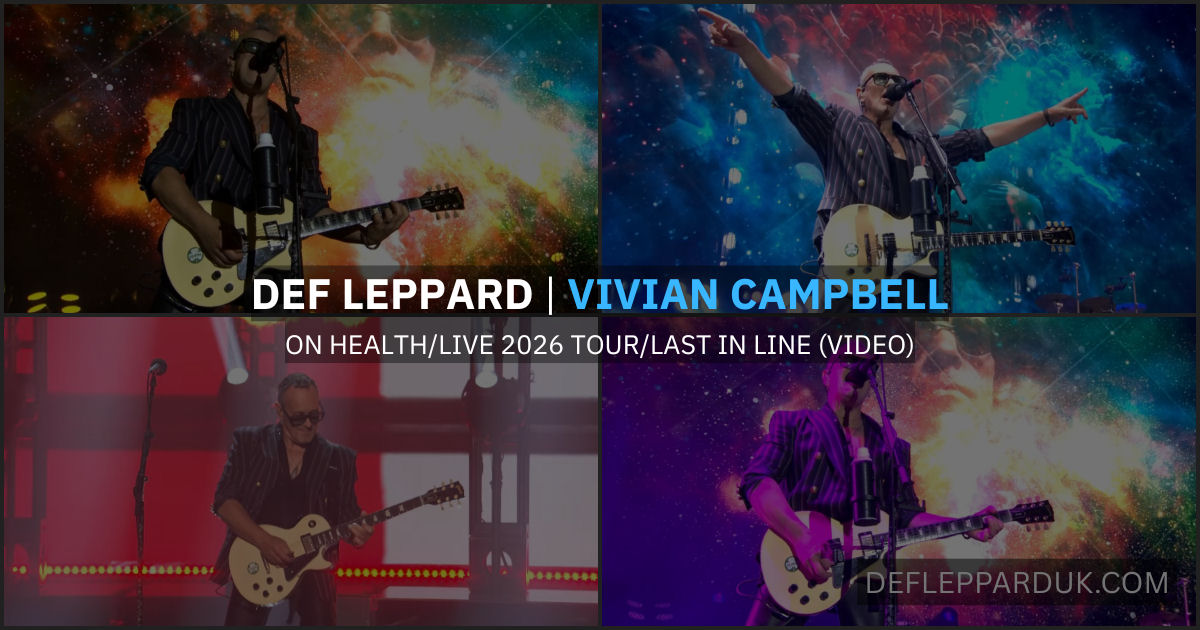
Def Leppard guitarist Vivian Campbell was recently interviewed and talked about his health, the Live 2026 tour and Last In Line.
The Live 2026 Tour continues in October and November with ten more shows scheduled.
Including a return to Mexico and South America.
El Salvador Video Interview
Def Leppard are set to return to El Salvador for the first time since April 1997 on 24th October.
The show in San Salvador takes place at the Cuscatlán Stadium and is the fifth date of the upcoming tour leg.
Vivian spoke to Radio Cadena YSKL FM in San Salvador ahead of the show and talked about the band's live show/sound, their studio sound, Last In Line, rally driving, touring, his health and the rise of A.I..
Health Update
The good news in the interview is that Vivian looked and sounded very well and is ready to resume the Live 2026 tour with Def Leppard.
Unfortunately when asked about his current health he shared that the bone marrow transplant that he had in early 2025 has not worked as hoped.
But he did sound positive about his 'ongoing treatment' and the possibility of another transplant.
Last In Line Return
Back in July 2025 singer Andrew Freeman made an online post suggesting the band had "run its course" and were likely over.
This came just after Vivian had suggested they had a four song EP almost ready to go and plans to recorded a fourth album that was already written.
Now Vivian has said the band will get back together in September to work together once more.
With no current live shows scheduled the band will write and record new music.
Read some quotes below and watch the full interview via the link.
Visit the Tour News section. For more news on future tour plans.
Visit the Album News section for more news on new music (based on band member quotes).
Vivian Campbell August 2026 Interview Quotes - (Transcribed by dltourhistory)
Hi, Mr. Campbell. Hello. You’re landing for the second time in El Salvador, and Salvadorans are a very loud crowd. How does this energy translate to the energy that you give us in an arena-based stadium?
Vivian Campbell: It always does translate. That is the one thing that makes a difference between Def Leppard playing in a rehearsal room and Def Leppard playing in front of an excited audience.
We always want to draw on the energy of the audience, and that amplifies us. That’s what we give back. When we feel that energy, it excites us even more to perform.
We expect that when we go to Central and South America. There’s always a passion that’s very evident.
When, before joining Def Leppard, you practically defined the sound of the heavy metal guitar with Dio, Whitesnake and Thin Lizzy, how does that lead to a more aggressive approach to the heavy metal guitar? How do you have to transform it when you join Def Leppard and its melodic approach to musical production?
Vivian Campbell: Yeah, I still bring that energy to my performance. Sometimes I need to rein it back. I do sometimes use too many pinch harmonics.
Whatever Def Leppard sounds like on record, it’s always a little higher energy when we perform it live. It elevates a bit. It’s a bit more aggressive when we do it as a live performance for various reasons, mostly because of the audience, because that lifts the excitement.
The great thing about live music is you feel it in your body. You don’t just hear it in your ears. Whereas when you listen to a recording, you’re hearing it in your head and your ears. But when you stand in front of a PA system and you hear a rock band, you feel it in every atom of your body.
The whole level goes up a lot. We sound much, much more like a hard rock band when you hear us live than we do on record. But I think that’s true of most rock bands.
Well, there’s something very special about Def Leppard. All through the different eras of rock and music production, the sound of Def Leppard has stayed true over the years.
For example, during the ’90s, when the grunge sound was the dominant sound, you produced Slang, which was a more raw, rock-based album. For example, in that era, how do you manage to survive the sound that was in fashion and stay true to your own style?
Vivian Campbell: Well, it doesn’t matter what style of song we do. In recent years, in particular, on recent albums, I think we’ve become even more diverse in terms of writing style.
Twenty, twenty-five years ago, I think when we were making records, the Euphoria record is a big example. In 1999, we were very specific about how we were going to sound for that record.
“We need this kind of song, this kind of song,” and they have to fit a formula that we were looking for.
On the records since then, I think we’ve allowed ourselves to be much more open to different styles. We all write differently. All of us in the band, we listen to different music, and when we write songs, they’re a little bit different.
But when you bring it all together, and when you put Rick’s drums on it, and when you put Sav’s bass and Phil’s guitar to my guitar, when you build it up, and then especially when you put Joe’s voice on top of it, it’s Def Leppard.
It doesn’t matter if the song was inspired by country music or R&B or street rock or whatever. It all ends up sounding like Def Leppard at the end of the day.
So we have that chemistry and that trademark sound that is undeniably Def Leppard.
I think one of the big, big parts of it is the layering of the vocals within this hard rock atmosphere. I think the vocals, more than anything else, have always defined Def Leppard — not just Joe’s vocals, but the overall vocals within a song, the background vocals.
And we can do that live, which makes an incredible difference because not many rock bands focus on the singing aspect the way that we do. We’ve always focused on it, we’ve always worked at it, and we do it incredibly well live.
We’re very, very proud of how we can replicate our sound in a live arena without resorting to recordings, you know, like pre-recorded tracks or whatever.
It’s all performed live, and we do it really, really exceptionally well.
Well, you have a side project, Last in Line. How do you manage creatively, or what do you take creatively from that smaller, if you will, club format, in contrast with the huge arena and live-stage explosive persona of Def Leppard?
Vivian Campbell: Yeah, so I haven’t done much with Last in Line for a couple of years for various reasons. I had to deal with my health for a while. That really sort of tabled the Last in Line stuff.
But we are picking back up in September. We’re going to write some new music and record.
But it is a very, very different thing. But I find that it energizes me to come back to Def Leppard after I’ve worked with Last in Line because it is very, very different in terms of, well, everything, really.
I mean, how we travel, where we play, the stage that we play on, the way that with Last in Line we meander and we jam and we go off on these weird tangents, whereas a Def Leppard show is extremely precise.
The production is locked in. Everything is fixed. It doesn’t move. And a Last in Line performance can go anywhere.
So, you know, there’s that aspect of it. Plus, as a guitar player, when I do Last in Line, it’s just guitar, bass, drums and vocals. So I’m the only guitar player in the band.
So I have to really reach into the toolbox, and I have to really perform and cover a lot of ground. And it is very, very challenging for me as a guitar player to go back and to play the early Dio stuff as faithfully as possible.
And the newer stuff that we recorded with Last in Line is of a similar standard for me.
So it energizes me as a guitar player so that when I go back to Def Leppard, I find it even easier to do the job. And when I find it easier to do the job as a guitar player, I find I’m more relaxed and I’m singing better, and my performance overall is better.
So I see it as a win-win situation.
You know, and it also makes me really appreciate things because when I travel with Last in Line to do shows, it’s very low-budget. It’s not easy.
We don’t travel well, we don’t stay in nice hotels, we don’t eat good food, we don’t get a lot of sleep.
Yes, the economics are very, very, very different. So when I go back to Def Leppard, it really makes me be appreciative of what we have.
It’s good every now and again to do that, to hit the reset button.
In terms of — you were talking about your health a minute ago — you have always been open about your lymphoma and your battle with this disease.
And you have shown extreme strength going on tour, battling with this condition. What is your mindset? How do you move forward, and what would be your message for those musicians or people in general who are battling their own health battles?
Vivian Campbell: Well, I think you have to keep moving forward. I do think that that’s what helped me, even when I was at a really low end with cancer treatment.
The fact that I could still continue to work — that gives me something to live for, something that you enjoy, that you’re passionate about, that you can wake up in the morning and look forward to.
I think that deflects, that takes away from focusing too much on cancer.
Unfortunately, I have met people in my life who, when they’ve gotten a cancer diagnosis, they’ve only focused on that. They think, “Oh, I can’t do anything. I need to stay in bed. I can’t eat this. I can’t do that. I can’t go there.”
I’ve never felt that way. I’ve always felt like I’m going to continue to live my life as much as possible.
In fact, even more so after getting a cancer diagnosis, it amplifies that desire to tick all the boxes, to do the things you want to do.
I also consider myself very fortunate because I caught my cancer early. It’s always been more about managing my cancer.
There’s only been one time that I felt it was going to kill me. In the winter of 2023, I got really scared about what was happening and the pace at which it was happening.
I realized at that point that I had to do a donor transplant. It was my only hope to survive. That’s what I did.
I did that in January of ’25. I did a donor transplant. Unfortunately, it didn’t stick. The cancer has returned.
I’m continuing treatments to manage it. I’ll probably have to do another transplant within a few years with another donor to try and see if maybe that would cure me.
In the meantime, I’m certainly not slowing down. I’m doing as much with my life as possible, not just with Def Leppard and, again, with Last in Line.
I’m also rally driving because I always wanted to do that.
Checking off the boxes in the back, at least.
Vivian Campbell: Yes, because I love cars and I love driving.
As a child, I always thought, “If I don’t play guitar for a living, I’m going to be a car driver.”
I’m very, very, very fortunate and blessed that I get to do both.
Life is for the living. I encourage everyone to look after their own health. If you are fortunate enough to get a cancer diagnosis, overcome the fear. Fear is inevitable when you’re first told those words.
Once you get over that, you’ve got to realize just how to manage it and how to deal with it as best as possible.
And just don’t give in.
There’s one aspect of the bands that were huge in the ’80s, especially in arena stages and stuff. There’s this special ability to sound with a very energized sound, maybe, but also to lower down and make it with the power ballads.
That very energized sound with the romantic and still very powerful, but at least a little bit less powerful than with the original sound.
Vivian Campbell: Yeah, the power ballads in the ’80s, some of them were great and some of them were not so great. It almost became, after a few years, very predictable.
I’m happy to say that Def Leppard’s power ballads are a lot more interesting.
“Love Bites” is the biggest one. It’s a very, very well-written song, and it incorporates certain elements of those dynamics, but not in a cheesy way.
I think dynamics overall are very, very important to any genre of music.
I would argue that hard rock, as a genre in particular, is not dynamic enough, that it’s too full-on most of the time. It doesn’t ebb and flow. It doesn’t breathe as much as it should.
As a performer, as a guitar player, I really try to do that. That makes a difference to me, and when I hear it in other musicians, I really appreciate it — that you can play with dynamics and bring the sound down as low as possible and pump it up as high as possible when need be.
Because that’s life. We all go through the day feeling certain things. At certain points in the day, you might feel really, really great and have high energy, and then at 6 p.m. in the evening, you might be really low energy.
Maybe you’ve got some bad news and you’re feeling very melancholy.
As human beings, we experience these different waves of feelings and emotions, and music should be, and has always been, a reflection of that.
Dynamics are extremely important to me, but they are very, very difficult to convey within the hard rock genre.
I do think that, personally, and in fact with my bandmates, with Def Leppard, we do have the skill set to do that live.
We can be very, very aggressive in a live arena, but we can also really bring things down and be very, very intimate when needed to be so.
Well, let’s talk about technology, something that we have to deal with.
In later years, artificial intelligence has become a huge conversation, especially in the arts. How do you think artificial intelligence is going to evolve or affect or change the way we deal with music production?
Vivian Campbell: Well, first, let me say that I know next to nothing about it, about artificial intelligence. In fact, I know next to nothing about technology in general.
In English, there’s an expression, a “Luddite.” It goes back to the first days of the printing press when people thought that that technology was going to ruin the world.
I consider myself a Luddite. I’m not into technology, certainly not into technology with regard to art of any sort.
I think it’s a tool, and you have to learn how to use it. Like every other tool, we adapt over time.
I don’t feel I’m qualified to really give an opinion on it, but I’m not in a hurry to want to use it. I don’t know if I personally ever will.
Having said that, I’ve heard songs, many songs actually, that have been created by artificial intelligence. It is pretty spectacular what it’s capable of producing, but that doesn’t make me feel good.
I still think that, going back to what we were just talking about, the human experience and emotions and the light and the shade and the different aspects of it and the depth of it — no machine is ever going to be able to replicate that.
It makes me wary about what’s coming in recording technologies, but it also, on the other hand, makes me grateful that live music still exists.
It makes me very grateful to be part of a band as good as Def Leppard, because we are one of the best bands in the world.
In fact, I think in our genre, we are the best band in the world. I think we’re in a class of one.
To be able to do that, you can’t replicate that with technology, artificial or not. It’s five guys playing music in real time, and I get to do that.
That’s a great privilege.
Finally, Mr. Campbell, this has been really a blast. We want to close with a message for the audiences down here in El Salvador.
They’re waiting for you eagerly, and they are expecting a huge show on the 24th of October. We’re seeing you in our country, so what can you tell them?
Vivian Campbell: I’m looking forward to the passion and the experience. I remember pretty well the last time that we were there.
I’m not sure of the name of the venue, but there was a bird inside the venue, and it pooped on my guitar amp.
For many years, I still had the poop all over the world. Wherever we went, I’d put up the amp, and there was bird poop on it.
I carried that around the globe. It was a great experience.
It’s exciting to go back, and I really look forward to the experience.
Well, let’s say, Mr. Campbell, I would like you to say hi to all our audience on the radio.
The radio’s called Caeli, so if you can say hi to all the people who are listening right now.
Vivian Campbell: Hi, Caeli people. We look forward to seeing you in October in El Salvador.
Thank you very much, Mr. Campbell.
Vivian Campbell: Thank you. Pleasure.
Watch the full interview at - youtube.com
Def Leppard Live 2026 North/South American Tour
Thursday, 15th October - Hollywood, FL @ Seminole Hard Rock Live
Saturday, 17th October - Querétaro, Mexico @ Autódromo de Querétaro - (New City)
Monday, 19th October - Mexico City, Mexico @ Palacio De Los Deportes
Wednesday, 21st October - Guadalajara, Mexico @ Arena VFG Guadalajara
Saturday, 24th October - San Salvador, El Salvador @ Cuscatlán Stadium - (Outdoor Stadium)
Thursday. 27th October - Alajuela, Costa Rica @ Anfiteatro Imperial Parque Viva - (First Time in Country)
Friday, 30th October - Quito, Ecuador @ Estadio Olimpico Atahualpa - (Outdoor Stadium)
Monday, 2nd November - Bogotá, Colombia @ Movistar Arena
Thursday, 5th November - Buenos Aires, Argentina @ Movistar Arena
Sunday, 8th November - Santiago, Chile @ Movistar Arena
Def Leppard / Latest Release
- Rejoice - (Digital Single)
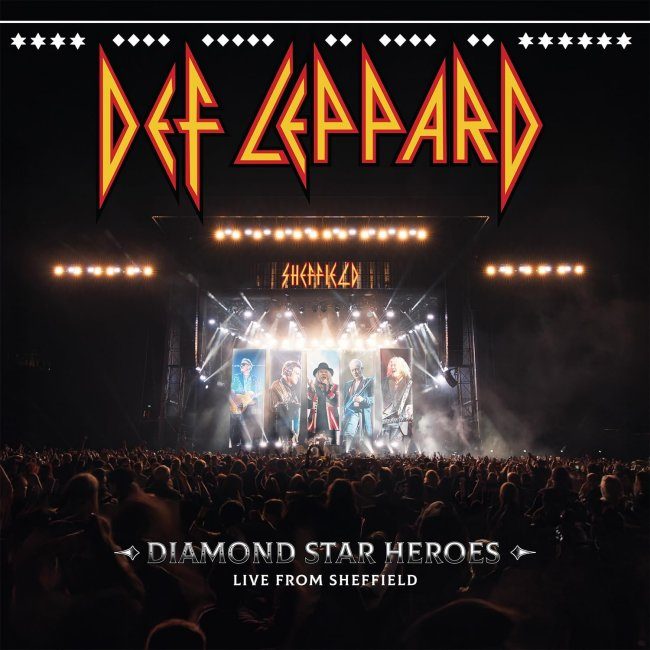
- Diamond Star Heroes Live From Sheffield - (Album - November 2025)
Def Leppard / Latest Tour
Related News - DEF LEPPARD Announce Live 2026 North/South American Tour
Related News - JOE ELLIOTT On DEF LEPPARD's 2026 Las Vegas Residency/Paris Show
Related News - JOE ELLIOTT Reflects On 2026 Las Vegas Residency/India Tour
Related News - DEF LEPPARD Cancel August Live 2026 Tour Show In DUBAI
Related News - PHIL COLLEN On DEF LEPPARD's INDIA Tour Setlist/Stage Production
Related News - DEF LEPPARD Ready To Rock India/Support Acts Announced
- Def Leppard - 2026 Tour
- Def Leppard - Interviews 2026
- Def Leppard - Tour News
- Previous News - 1st June 2026
- Back
share this story:

explore def leppard tour history


